SwissAnon at Data Protection Day 2026: Four Hands-On sdcMicro Workshops in Zurich
SwissAnon was on the programme at Data Protection Day 2026, hosted by the Data Stewards Network of the University of Zurich on Monday, 22 June 2026. The day paired a morning of plenary talks — on information security, data protection law, secure computing, AI and confidentiality, and publishing sensitive data — with an afternoon of hands-on workshops that participants rotated through by interest.
Representing SwissAnon, Prof. Dr. Matthias Templ (FHNW) — the lead developer of
sdcMicro — led Workshop 1, “Working with sdcMicro.”
Because each afternoon session restarted every half hour so different groups could attend, the workshop
was delivered four times in a row between 14:00 and 16:00.
The premise: removing names, e-mails and birthdates is where anonymization starts, not where it ends.
Working live in the sdcMicro app, participants measured the disclosure risk of an individual-level
dataset, then applied the core techniques — global recoding, local suppression and perturbation — inside
a reproducible workflow, watching the re-identification risk fall while keeping an eye on the analytical
value they were preserving. That privacy–utility trade-off is the heart of statistical disclosure control,
and seeing it move in real time is what makes the point stick.
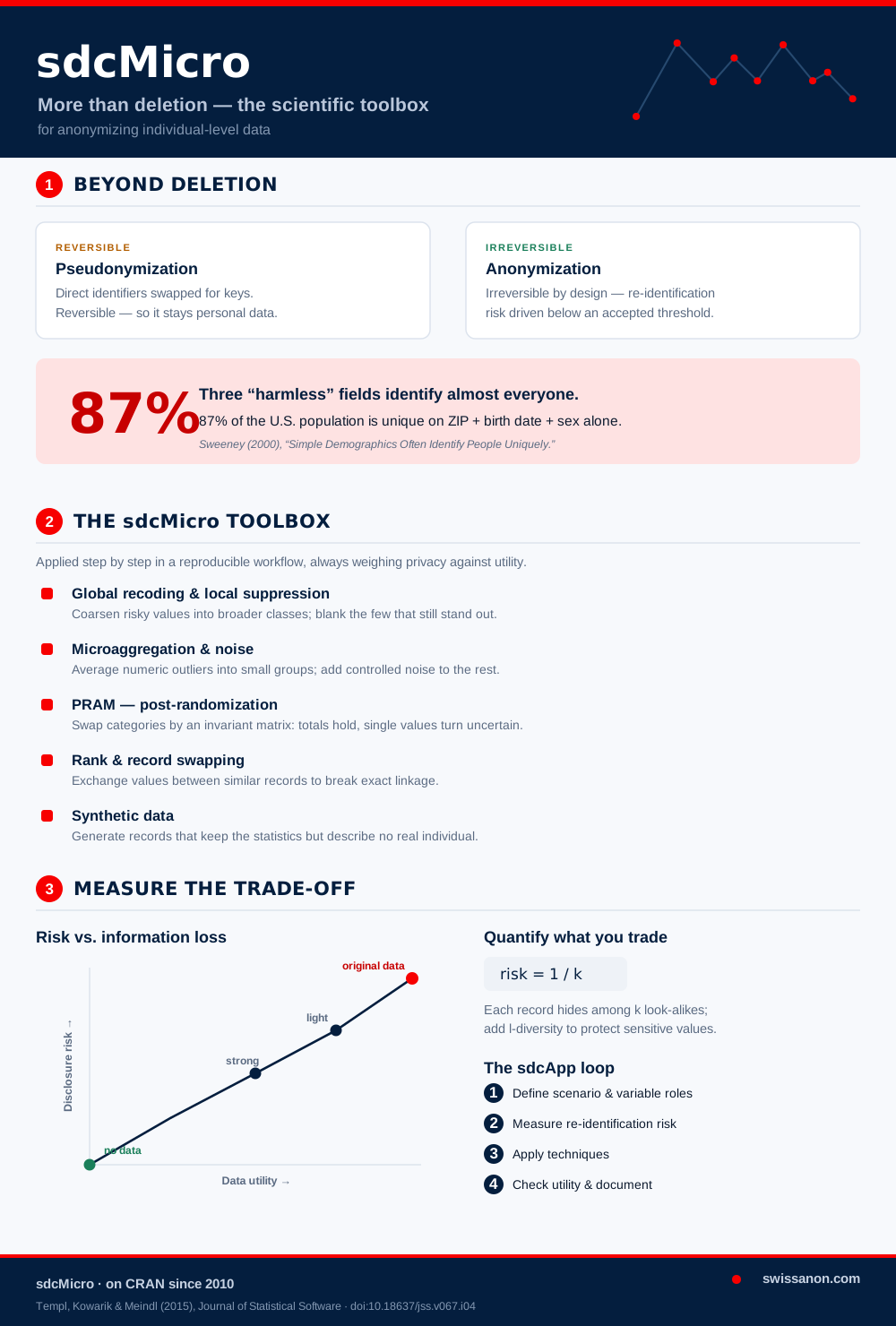
The demonstration used a real depression study (Colman, Vione & Kotera, 2020; n = 107, already stripped of direct identifiers), which still began around 56 % re-identifiable on its quasi-identifiers alone — a concrete reminder that “de-identified” is not the same as “anonymous.” Over the session it was brought down to a safely shareable state, entirely with open-source, reproducible tooling.
The workshop was one of five running in parallel across the afternoon, alongside sessions on anonymisation tooling, MRI data, data classification and security, and a data-sharing Q&A. For SwissAnon, events like this are exactly how the research behind our SNF Bridge project reaches the people who share sensitive data day to day.
Try it yourself. The slides, the demo R script and the prepared dataset from the session are on the companion page at swissanon.com/dpd2026. To get started with the tool itself:
install.packages("sdcMicro")
library(sdcMicro)
sdcApp()          # launches the point-and-click GUI
sdcMicro has been on CRAN since 2010 and is documented in the Journal of Statistical Software
(Templ, Kowarik & Meindl, 2015); its point-and-click app is
described in Algorithms (Meindl & Templ, 2019).