
Identifying high-risk records in synthetic data with RAPID at the Swiss Statistics Meeting 2026
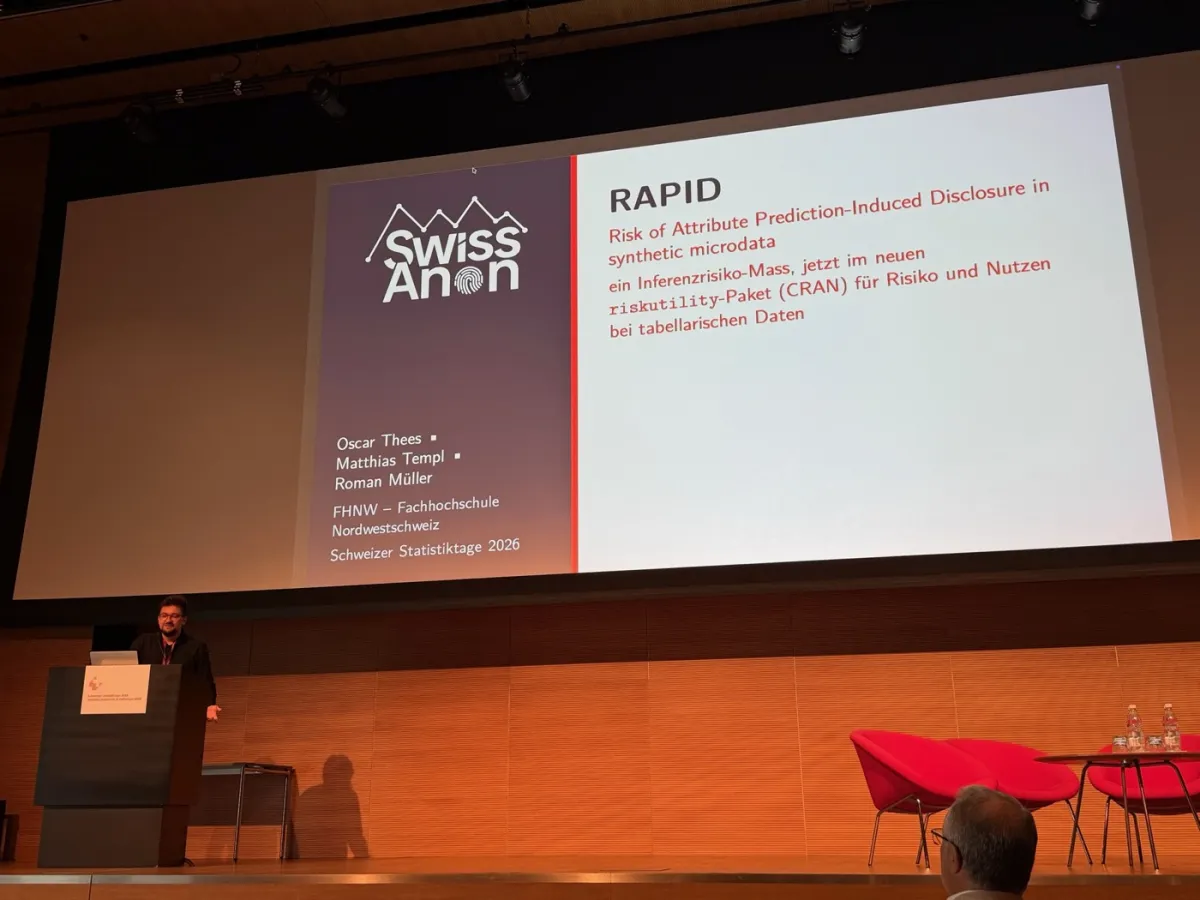
On 25 August 2026, Oscar Thees presented our contribution Identifying High-Risk Records in Synthetic Data with RAPID at the Swiss Statistics Meeting 2026 (Schweizer Statistiktage) at Würth Haus Rorschach, hosted by the Office for Data and Statistics of the Canton of St. Gallen.
The talk began with a thought experiment. B secretly X-rays A’s briefcase and sees what is inside. Clearly a privacy violation. In a second version, B never touches the case but infers the same content from a few visible features using a model, with the same evidential weight. No access, just a prediction. Is that still a violation? The symmetry thesis (Munch, 2021) argues that the difference is real but morally inert, because everything we invoke to justify privacy (consequential harm, being judged, autonomy) applies to the prediction too. Differential privacy starts elsewhere: a violation occurs only if the result depends on whether a single person was in the data.
RAPID does not settle this debate. Under either reading, however, a data holder wants to know how much inference a release enables. Synthetic data does not take care of that on its own: it breaks the link to real people, but every dependency it preserves is the attacker’s lever.
RAPID (Risk of Attribute Prediction-Induced Disclosure) makes that evidential weight measurable. The attacker is simulated as a machine-learning model, trained on the released data, that predicts the sensitive attribute from quasi-identifiers and is checked against the true values of real individuals. A baseline correction matters: if 90% of patients are healthy, “healthy” is 90% right without any attack. The output is a risk flag per record, together with the quasi-identifier patterns behind it.
RAPID is one of around 100 risk and utility measures in riskutility, our new R package on CRAN.
- RAPID paper: arXiv:2602.09235
- riskutility on CRAN: cran.r-project.org/package=riskutility
- Abstract: Swiss Statistics Meeting programme (Book of Abstracts, p. 13)
The work is joint with Roman Müller and Matthias Templ.